
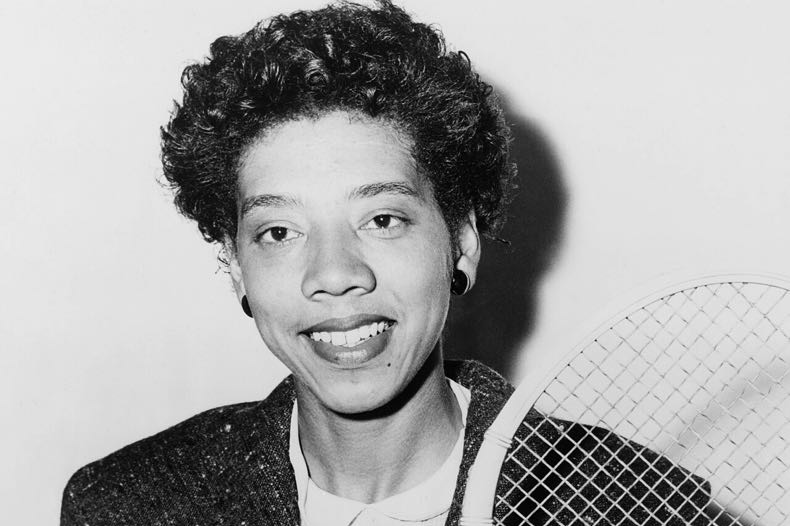

When Althea Gibson walked onto the court at the US National Championships (today’s US Open) in 1950, she was doing far more than competing in a tennis tournament. She was the first Black player ever to enter the event, breaking a colour barrier that had kept African Americans out of one of the biggest tournaments in the sport.
To reach this point, Gibson had come a very long way from her childhood in Harlem. Born into a sharecropping family in South Carolina, she discovered tennis as a teenager after first developing her talents in paddle tennis. Her ability quickly became impossible to ignore, but her path into the highest levels of the sport was far from straightforward.
Major tennis tournaments were largely held at exclusive clubs where Black players were not permitted to compete. Gibson therefore had to overcome barriers away from the court before she could prove herself on it. With the support of fellow players, coaches and influential figures in the sport, she eventually earned her opportunity at Forest Hills.
Though she exited the US National Championships in the second round, what followed was a remarkable rise. Gibson became the first Black player to win a Grand Slam singles title when she triumphed at the French Championships in 1956. A year later, she won both Wimbledon and the US National Championships, becoming the first Black woman to win either title.
Her tennis achievements made Gibson one of the most important figures in the sport’s history, but her impact was also felt elsewhere as she later became the first Black woman to compete on golf’s LPGA Tour.
From South Carolina to Harlem
99 years ago today, my Shero, Althea Gibson, was born.
Last year, we celebrated the 75th anniversary of Althea breaking the color barrier in tennis at the U.S. Open.
This year, let’s continue to remember her courage and strength, and how she blazed a trail for so many to… pic.twitter.com/VZ8iwUULNi
— Billie Jean King (@BillieJeanKing) August 25, 2026
Gibson was born on 25 August 1927 in Silver, South Carolina, where her parents worked as sharecroppers. Her family moved to Harlem in 1930, looking for better opportunities during the difficult years of the Great Depression. Her home in Harlem, down 143rd Street, featured a Police Athletic League area. Through this, a young Gibson discovered a real natural talent for paddle tennis. So much so, in fact, that by the age of 12, she was crowned New York City women’s paddle tennis champion.
Tennis soon lost its appeal, though, as Gibson turned to street fighting and basketball. Despite this, neighbours helped finance a junior membership and lessons at the Cosmopolitan Tennis Club in Sugar Hill. Thanks to this, Althea won the American Tennis Association (ATA) New York State Championship in 1941, followed by the ATA national championship in the girls’ division in 1944 and 1945. In 1947, she claimed the women’s title, in what would be the first of 10 consecutive victories in the event.
Her progress was aided by Dr Robert Walter Johnson, a physician and prominent Black figure in tennis who became her mentor and sponsor. He provided Gibson with coaching and opportunities to compete against stronger opposition, helping prepare her for the next stage of her career.
Breaking the Colour Barrier

Despite her success, Gibson could not simply enter the biggest tournaments in the United States. The US National Championships were held at a private club, and Black players had historically been excluded from the event. Things began to change in 1950, though, as players and other figures lobbied for Gibson to be allowed to compete. Former US champion Alice Marble was among the most prominent supporters, and she wrote a scathing editorial in American Tennis Magazine denouncing the existing all-white policy.
The campaign succeeded thanks to the passion of people like Marble. Subsequently, Gibson received an invitation to the US National Championships, becoming the first Black player to compete in the tournament. She defeated Barbara Knapp in the opening round before facing defending Wimbledon champion and third seed Louise Brough. Gibson lost the match, but her appearance received extensive media coverage.
Gibson continued to make history the following year. In 1951, she became the first Black player to compete at Wimbledon, reaching the third round before losing to fifth seed Beverly Baker. She also won her first international title, the Caribbean Championships in Jamaica.
Reaching the Top of Tennis
After developing her game in the years following her breakthrough, Gibson became one of the best players on the circuit by 1956. During this year, she won the French Championships (French Open), becoming the first Black player to win a Grand Slam singles title. She also won the women’s doubles title in Paris alongside Britain’s Angela Buxton and reached the singles final of the US National Championships.
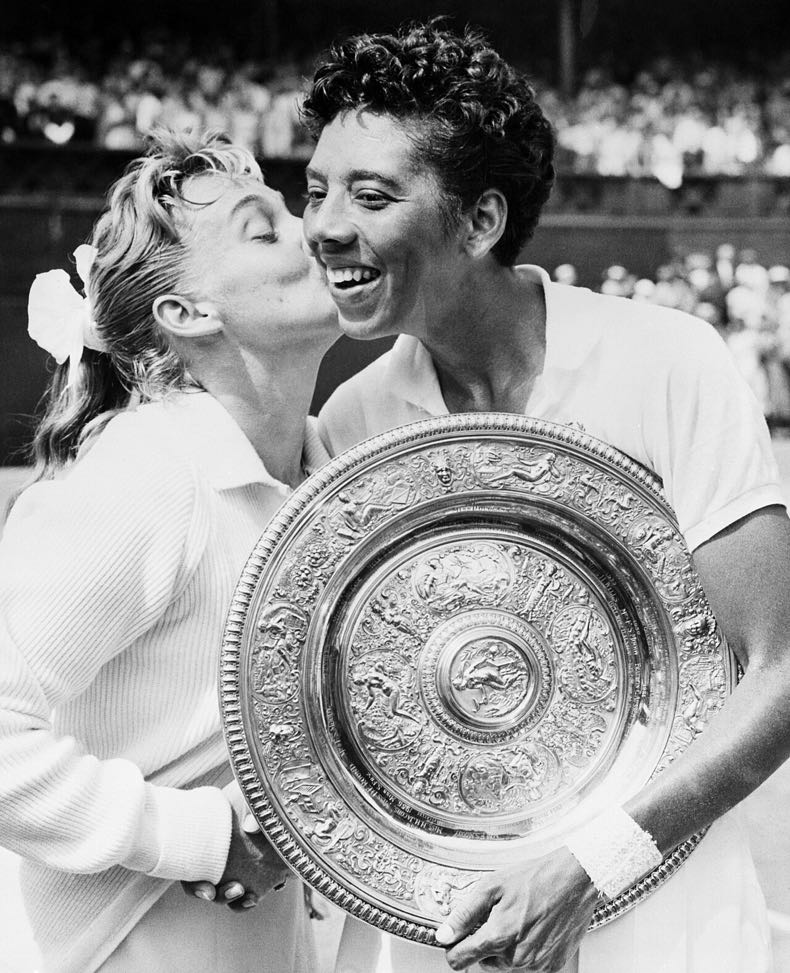
The following year, seeded number one at Wimbledon, Gibson defeated Darlene Hard in the final to become the first Black player to win the women’s singles title at the All England Club. She then returned to the United States and won the women’s singles title at the US National Championships, defeating Brough in the final. Her victory prompted a ticker-tape parade through New York and cemented her position among the biggest names in American sport.
She successfully defended both Grand Slam titles in 1958. Gibson defeated Angela Mortimer Barrett in the Wimbledon final and Hard in the US National Championships final, becoming a two-time champion at both tournaments. This saw her remain as world number one, something she first earned in 1957, and she was named Associated Press Female Athlete of the Year in both years. Such was her sporting pedigree that Gibson became the first Black woman to appear on the covers of Time and Sports Illustrated.
By the end of 1958, when she retired from amateur tennis, she had won 58 combined singles and doubles titles during her career.
A New Challenge in Golf


Having earned little money from her tennis career, as major events were limited to amateurs, Gibson began exploring other avenues, including music and acting, before turning her attention to golf. Gibson took up golf under the supervision of local legend Jerry Volpe, who trained many celebrities. Volpe gave Gibson honorary membership at Englewood Golf Club in New Jersey, and in doing so she became its first Black member.
In 1963, Gibson became the first Black woman to compete in the US Women’s Open. She missed the cut by one stroke, but her participation represented another significant moment in her career. She later became a member of the LPGA Tour, making her the first Black woman to compete on the professional women’s golf circuit. Gibson remained involved in professional golf for many years and made 171 LPGA Tour starts between 1963 and 1977.
Her golf career did not match the success she had enjoyed in tennis, with her best ever ranking being 27th in 1966, but simply reaching the tour represented another barrier broken.
Althea Gibson’s Legacy


Gibson’s impact can be seen in how long her achievements stood alone. It was 15 years before another non-white woman, Evonne Goolagong, won a Grand Slam title, while it took 43 years for another African-American woman to win a Grand Slam singles title, when Serena Williams won the 1999 US Open.
Gibson was inducted into the International Tennis Hall of Fame and became the first woman to receive the NCAA’s Theodore Roosevelt Award in 1991. She was also one of the first six inductees into the International Women’s Sports Hall of Fame. Her honours continued after her death, with a bronze statue unveiled in Newark in 2012 and another at the US Open site in Flushing Meadows in 2019.